
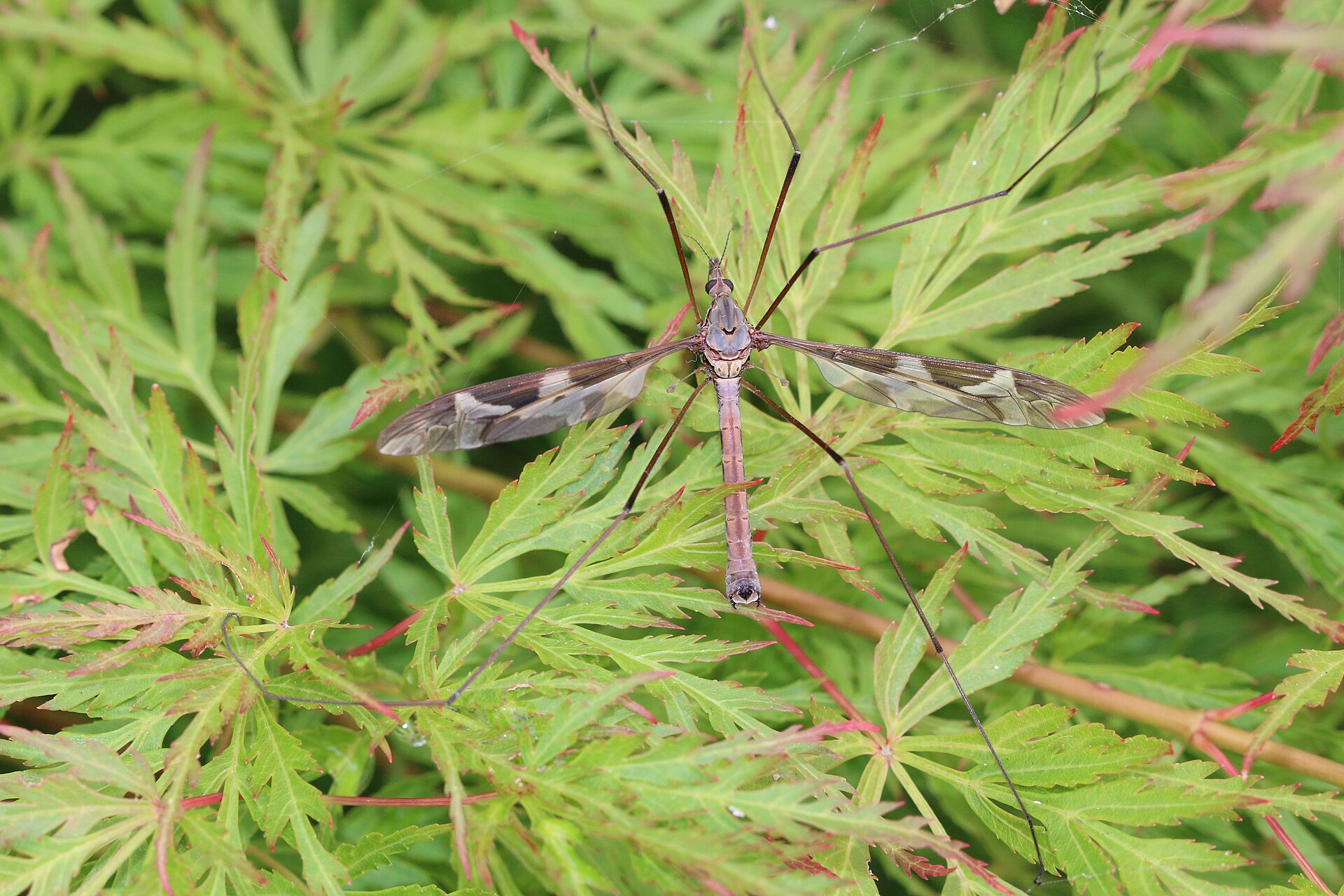
The insects New Jersey calls Jersey skeeters are crane flies, not mosquitoes. They cannot bite you.
Crane flies are large, delicate true flies in the family Tipulidae. They look like mosquitoes built at three times the size. But adult crane flies have no biting mouthparts at all. They do not bite people or pets, they do not suck blood, and they do not spread disease. One on your porch is harmless and gone within days.
Crane flies belong to Tipulidae, a separate family from mosquitoes. The resemblance is real, but the family tree split long ago.
Adult crane flies have no proboscis for piercing skin. Most feed lightly on nectar or not at all in their short lives.
The young live in damp soil, mulch, and stream edges. They feed on decaying leaves and break them down.
Every New Jersey homeowner knows the moment. Something enormous and leggy lands on the screen door. It looks like a mosquito the size of a small bird. Around here it has a name: the Jersey skeeter. The name, it turns out, is a case of mistaken identity.
What a Jersey skeeter actually is
A Jersey skeeter is a crane fly, a member of the family Tipulidae. A typical adult has a slender body around an inch long and one pair of wings. It has very long, fragile legs. The legs dangle as it flies and snap off easily.
That mosquito shape is no coincidence. Crane flies and mosquitoes are distant relatives. But a crane fly never grew the mosquito’s defining tool. A female mosquito carries a needle-like proboscis for piercing skin and drawing blood. A crane fly’s mouthparts are soft and short, suited at most to sipping nectar. The hardware for biting simply is not there.
Why they gather on porches, siding and screens
Crane flies emerge in waves. New Jersey usually gets two: spring, and late summer into fall. The adults live only a few days to about two weeks. They spend that time mating and laying eggs in damp ground. Porches and house walls sit right in their flight path. They offer sheltered surfaces to rest on. Lights there draw night-flying insects in.
The other half of the story is underground. Females lay eggs in moist soil, wet turf, mulch, and leaf litter. The grayish young, sometimes called leatherjackets, feed there for months on decaying plant matter. Yards with watered lawns, heavy mulch, and shady wet corners are prime habitat. A hatch there can look like an invasion.
Crane fly or real mosquito: how to tell
Size is the first clue. Even New Jersey’s largest real mosquitoes are far smaller than a crane fly. Anything mosquito-shaped with a body around an inch long is a crane fly. Next, look for the V-shaped groove on top of the body, just behind the head. Crane flies carry that marking; mosquitoes do not. A mosquito’s proboscis points forward like a tiny spear. A crane fly’s snout is blunt and soft.
Behavior settles it. Mosquitoes fly with purpose, land quietly and get to work. Crane flies are poor fliers. They drift and bounce along walls. They dangle their legs and blunder into lights. If the insect seems too clumsy to be dangerous, it is almost surely a crane fly.
The daddy longlegs mix-up
Crane flies often get called daddy longlegs. But that nickname belongs to at least two other animals as well. It is the standard name for harvestmen, the round-bodied arachnids of garden walls. Many people use it for cellar spiders too. All three are harmless to people. But they are not the same creature. None of them is a mosquito.
The old playground claim says daddy longlegs carry the strongest venom of any spider, but cannot bite through skin. That claim is a myth. There is no evidence behind it. The crane fly on your porch cannot bite at all. It is not a spider in the first place.
What to do about them: mostly nothing
Adult crane flies are harmless and short-lived. There is nothing to control and no treatment worth doing. A wave that looks alarming on Tuesday usually fades within the week as the adults die off. Indoors, the fix is a cup and a piece of paper. They do not infest houses, breed indoors or damage food, clothing or wood.
If numbers around the porch bother you, small tweaks help. Porch lights draw them at night. A warmer bulb, or lights off when not needed, reduces the crowd. Sealing gaps around screens and doors keeps strays outside. The young, meanwhile, spent those months in your soil, quietly chewing through decaying matter.
The one big New Jersey mosquito that really does bite
None of this means every large mosquito-shaped insect is harmless. New Jersey does have one truly big biting mosquito, the gallinipper. It is a floodwater species. It is famous for a bite you feel through a shirt. It is still nowhere near crane fly size. Telling the two apart is just the skill this article is about.
For the full size picture, from the tiny species you never see to the gallinipper at the top of the range, read our companion guide on how big New Jersey mosquitoes actually get: if it looks like a mosquito the size of a quarter, it is a crane fly, and you can go back to your evening.
Know the real mosquitoes from the look-alikes
With the giant sorted out, learn which real New Jersey mosquitoes deserve your attention, including the one bold enough to bite at noon.
Two useful follow-ups
Can a Jersey skeeter bite me or my dog?
No. Adult crane flies have no biting mouthparts and cannot pierce skin, yours or your pet’s. If you get bitten while one is nearby, the bite came from a real mosquito or another biting fly. It did not come from the crane fly.
Do crane flies eat mosquitoes, like the name mosquito hawk suggests?
Not as adults. The mosquito hawk name is folklore. Adult crane flies feed lightly on nectar or not at all. They do not hunt mosquitoes. A few crane fly young hunt in wet soil. But porch adults control nothing.
Why are there suddenly dozens on my porch at night?
You are seeing a hatching wave. Adults hatch over a short window. They gather near lights and sheltered walls. They mate and die within days. The crowd looks dramatic, but it thins out on its own.
Where this information comes from
Jersey Mosquito uses facts from public health, government, and college sources. It adds tips for New Jersey yards. This article is for learning. It is not medical advice. It is not an official state health notice.
Want professional mosquito control for your yard?
Jersey Mosquito is the education side. Bite Back Tick & Mosquito Control treats yards across its New Jersey service area.