
Asian Tiger Mosquito
The Asian tiger mosquito is one of the most recognizable and frustrating suburban mosquitoes in New Jersey: small, dark, sharply white-marked and willing to bite in daylight around shaded yards.
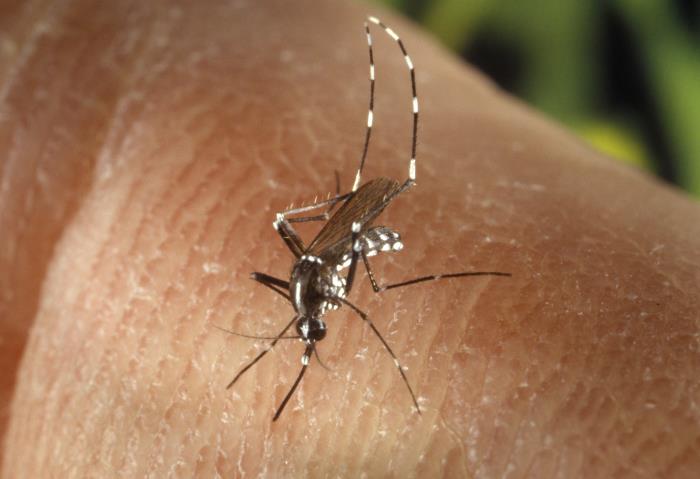
Black-and-white, aggressive, and closely tied to containers.
A bright white stripe down the top of the thorax, contrasting white leg bands and persistent daytime biting are the strongest homeowner clues. Rutgers describes it as an opportunistic container breeder that can develop in very small collections of water.
A sharp close photo showing the thorax and legs can be strongly suggestive. Damaged scales or poor lighting can still make identification uncertain.
Adult identification
Adults are dark with conspicuous white markings. The single pale longitudinal line on the thorax is especially useful, along with contrasting white bands on the legs. The overall look is much bolder than a plain brown Culex.
Larval habitat
Rutgers describes artificial containers as typical habitat. Tires, buckets, cups, drums, wheelbarrows and other confined water sources can support larvae; natural containers can also be used.
- Inspect flowerpot saucers and decorative containers
- Check toys, buckets and storage clutter
- Look inside corrugated drains and clogged gutters
- Do not ignore tiny water pockets
Biting behavior
This is a classic daytime-biting yard mosquito. Bites can occur around shaded shrubs, decks and landscaping during the day as well as around the edges of dusk.
Season in New Jersey
Rutgers describes larvae as present through the season and notes a multivoltine life cycle, meaning multiple generations can develop while conditions remain suitable.
Why it matters around homes
Its container-breeding habits put the source directly into residential environments. Source reduction can therefore make a meaningful difference, but neighborhood sources can continuously reintroduce adults.
What to do
Remove or manage water repeatedly, not once. Combine water-source correction with attention to dense shaded resting habitat and airflow around the places people actually use.
Aedes japonicus and Aedes triseriatus
All three can use containers. The Asian tiger’s bold black-and-white adult pattern is the homeowner-friendly clue. Japonicus is generally bronze-brown with pale markings, while triseriatus has darker legs/proboscis and silvery scales on the thorax sides.
Identification questions
Can Asian tiger mosquitoes breed in a tiny amount of water?
Yes. Rutgers documents this species in a broad range of small artificial containers and notes its ability to use very shallow water.
If I am bitten in daylight, is it definitely an Asian tiger mosquito?
No. Daytime biting is a strong clue, not proof. Other mosquitoes can seek hosts during the day under the right conditions.
Do they stay in one yard?
Adults can move between neighboring properties. That is why correcting your own water matters even though it cannot eliminate every outside source.
When identification points to a property-level problem, Bite Back can handle the professional side.
Jersey Mosquito stays educational. Bite Back is the service company for homeowners who want professional mosquito control in New Jersey.