
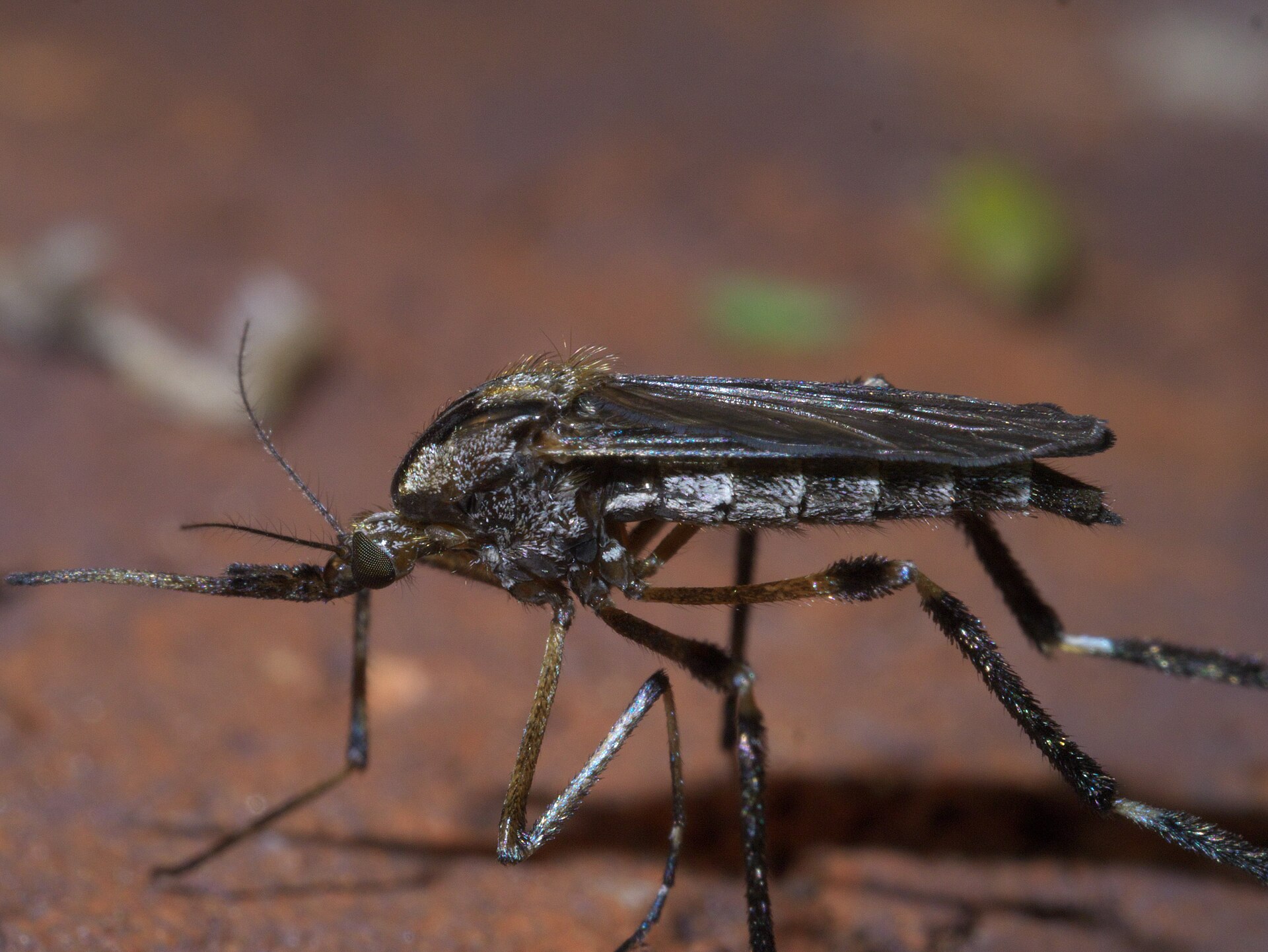
Most New Jersey mosquitoes are only 4 to 7 millimeters long. That is about a quarter inch or less. Even the biggest biting species is far smaller than a crane fly.
A typical yard mosquito is smaller than the width of a dime. A dime is about 18 millimeters wide. The smallest species are easy to miss. At the top of the range sits the gallinipper. It is a floodwater mosquito, much larger than the rest, with a bite to match. One rule covers most backyard confusion. If it looks like a mosquito the size of a quarter, it is almost surely a crane fly, not a mosquito.
That is a quarter inch or less of body length. The mosquito whining at the patio table is much smaller than it feels.
Psorophora ciliata is the state’s largest biting mosquito. It is a floodwater species. It appears after heavy rain, and its bite hurts.
Toxorhynchites is one of the largest mosquitoes of all. Its young (larvae) eat the young of other mosquitoes. Adults feed on nectar, not blood.
Ask New Jersey homeowners how big a mosquito is. Answers run from a speck to a small aircraft. Memory makes them bigger. Dusk light flatters them. Crane flies keep crashing the lineup. Here is the size guide. It runs from the species you never notice to the one biter that earns the word big.
The normal range: smaller than a dime
Most mosquitoes that bite in New Jersey measure 4 to 7 millimeters in body length. That is roughly a quarter inch or less. A dime is about 18 millimeters wide. A typical mosquito’s body covers barely a third of it. The common house mosquito and the Asian tiger mosquito sit in this modest range. They are the two species behind most New Jersey bites.
This is why real mosquitoes are so hard to swat and so easy to underrate. The insect is a few millimeters of body on long legs. Its wings make it look bigger in flight. On a ruler, the average backyard mosquito is a small animal.
The small end: biters you barely see
Several New Jersey species run even smaller than the average, down toward 3 or 4 millimeters. They can feed before you ever spot them. The Asian tiger mosquito shows the effect well. Bold markings make it look big in photos. But it is a compact insect. It lands lightly and bites ankles in full daylight. It often goes unnoticed until the itch starts.
Small size is also why checking by eye misses part of the problem. Young mosquitoes in a bottle cap of water stay under the radar. Tiny adults resting in shaded leaves do too. A yard can feel empty at noon. It can still hold plenty of small mosquitoes waiting for evening.
The gallinipper: New Jersey’s biggest biter
The gallinipper, Psorophora ciliata, is the real thing. It is the largest biting mosquito in New Jersey. It is one of the largest in North America. It runs two to three times the size of a common yard mosquito. It has a shaggy, scaled body close to a half inch long. It has bold bands on its legs. Scientists at the University of Florida say its bite feels like being stabbed.
Gallinippers are floodwater mosquitoes. Females lay eggs in low ground that floods. The eggs wait out dry spells. Adults emerge in numbers after heavy rain. They fly well and bite day and night. They come in spells. A wet spell brings a week of them you will not forget. Then they fade until the next flood.
The elephant mosquito: biggest of all, and on your side
The one New Jersey mosquito larger than the gallinipper does not bite at all. The elephant mosquito, Toxorhynchites, is a big, iridescent species. Its curved proboscis is built for sipping nectar and plant juices, not piercing skin. Adults cannot take a blood meal. So they never bite people or animals. They never spread disease.
Better still, its young are predators. Young elephant mosquitoes grow in tree holes and water-filled containers. They spend their youth eating other young mosquitoes in the same water, often in large numbers. A large, metallic-looking mosquito with a downward-curved snout is one of the few insects you can thank. Just leave it alone.
Bigger and chunkier: the cattail mosquito
Between the everyday species and the gallinipper sits the cattail mosquito, Coquillettidia perturbans. It is a stout, speckled mosquito on the bigger, chunkier side of the range. It feels heavier when it lands. Its pushy dusk biting makes it seem larger than it measures.
Its size comes with an unusual childhood. Young cattail mosquitoes do not rise to the surface to breathe like most young mosquitoes. They pierce the roots of cattails and other marsh plants. They draw air from the plant itself and stay hidden underwater. That is why it pours out of wetlands in early summer. It is also why draining does nothing to stop it.
Why mosquitoes seem bigger in the fall
Every autumn, reports of giant mosquitoes roll in, for two reasons. First, the species mix changes. Late season rain hatches floodwater species. They run larger than the midsummer regulars. The mosquitoes flying in October are a different crowd than the ones from July.
Second, fall is crane fly season. The giant mosquito look-alikes New Jersey calls Jersey skeeters emerge in a big late summer and fall wave, landing on screens and siding just as real mosquitoes are winding down. Quarter-sized means crane fly, harmless and unbothered. The real biters, even the gallinipper, stay well under that mark.
Put a name to what you are seeing
Size gets you most of the way to an identification. These guides finish the job.
Two useful follow-ups
Can a mosquito really get as big as a quarter?
No biting mosquito comes close. A quarter is about 24 millimeters across. Even the gallinipper’s body is around half that. Insects that size with a mosquito shape are crane flies, the Jersey skeeters. They cannot bite.
Do bigger mosquitoes bite harder or spread more disease?
Size alone is a poor guide to risk. The gallinipper’s bite hurts more. But the species that matter most for disease in New Jersey are ordinary mid-sized ones. The house mosquito is one of them. A big mosquito is mostly a bigger nuisance, not a bigger health concern.
Why did the mosquitoes at the Shore seem so much bigger?
Salt marsh species are sturdy, strong-flying mosquitoes. Marshes release them in huge numbers on a good wind. Big swarms of medium-sized mosquitoes look like giant mosquitoes, especially at dusk. The truly huge insects mixed in are, once again, usually crane flies.
Where this information comes from
Jersey Mosquito uses facts from public health, government, and college sources. It adds tips for New Jersey yards. This article is for learning. It is not medical advice. It is not an official state health notice.
Want professional mosquito control for your yard?
Jersey Mosquito is the education side. Bite Back Tick & Mosquito Control treats yards across its New Jersey service area.