
Coquillettidia perturbans
Coquillettidia perturbans has one of the stranger mosquito life cycles in New Jersey. Its larvae get oxygen from submerged plant tissue, which ties this species closely to cattails and other wetland vegetation.
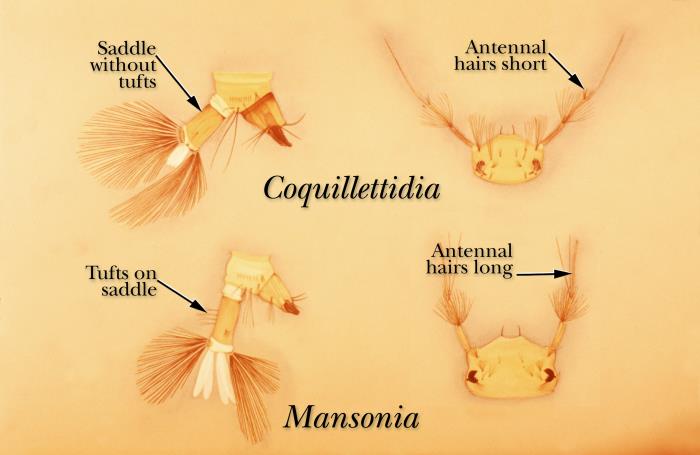
Its young ones (larvae) stay fixed to plants. Most young ones come to the surface. These do not.
Rutgers describes its egg sites near roots and stems. The plants grow out of water in bogs, ponds, and lakes. Its life cycle makes this a wetland issue. It is not a standard flowerpot mosquito.
The CDC image here shows the young form of this group. An adult ID should use a proper ID key.
Unusual larval biology
Coquillettidia young ones use changed breathing tubes. The tubes fix them to plant roots or stems. They get oxygen (air) from the plant. They do not come up to the surface again and again.
Typical habitat
Rutgers stresses plants that grow out of fresh water. They grow near bogs, ponds, and lakes. Cattails and plants like them can be key homes.
Why New Jersey mosquito programs watch it
Rutgers found this species in Ocean County work. The work was tied to EEE in horses and in mosquito samples. That is one reason control programs watch it.
Why control is challenging
Young ones hide among plant roots. They do not act like standard young ones that breathe at the surface. So mapping and treating their homes takes more skill.
Adult pressure
Adults can bite again and again. They may move from wetlands into home areas.
What this means around a home
Here too, the source can be a wetland past your yard. County tracking and knowledge of local sites become key.
Container-breeding Aedes
Aedes albopictus can grow in a cup. Coquillettidia perturbans is tied to plants rooted in water. The plants grow above the surface. Its young ones breathe in a distinct way.
What people usually want to know
Do Coquillettidia larvae come to the surface to breathe?
They are built to get oxygen (air) from plant tissue under water.
Can they breed in a backyard bucket?
That is not their true home. Wetlands with plants that grow out of water are the key setting.
Why include them in a homeowner guide?
Adults from wetlands can affect an area. The yard itself may not be making them.
Next, ask if you can fix the source yourself.
Keep checking the water and resting areas first. If mosquitoes still make the yard hard to use, Bite Back gives mosquito control for New Jersey homes.