
Common Malaria Mosquito
Anopheles quadrimaculatus is historically famous as an eastern U.S. malaria vector, but for identification today the useful lesson is morphological: Anopheles mosquitoes look and behave differently from the Culex and Aedes most homeowners picture.
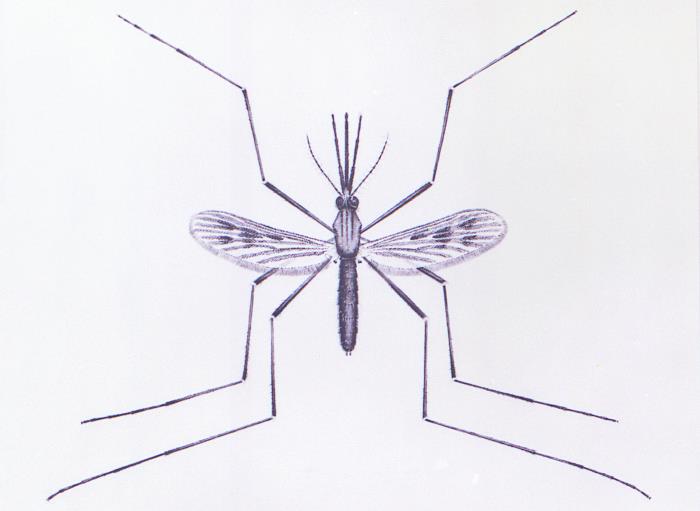
Wing spots, long palps and Anopheles-style larval posture.
Rutgers describes large dark-brown adults with four dense patches of scales on each wing. CDC comparison keys emphasize the long palps of female Anopheles; larvae lie almost parallel to the water surface because they lack the long respiratory siphon typical of Culex.
A good specimen can often be recognized as Anopheles; separating members of the quadrimaculatus complex is more technical.
Adult identification
Rutgers describes large dark-brown mosquitoes with four dense patches of wing scales. Female Anopheles have long palps roughly comparable to the proboscis.
Larval posture
Anopheles larvae sit almost parallel to the water surface, unlike many Culex and Aedes larvae that hang down using a respiratory siphon.
Habitat
Rutgers describes larger water bodies such as reservoirs, lakes, canals, rice-field-like habitats and permanent-water swamps with surface or emergent vegetation.
Biting behavior
Female Anopheles generally seek hosts in the evening or at night. CDC notes late-evening/night biting behavior for Anopheles quadrimaculatus.
Historical context
This species complex was historically important in malaria transmission in the eastern United States. That history should not be confused with a claim that local NJ mosquitoes currently carry malaria.
Identification nuance
Rutgers describes a sibling-species complex whose members can require specialized methods to separate. A field guide should stop where the evidence stops.
Culex mosquitoes
Female Anopheles have long palps and different larval posture. CDC PHIL has a useful head-structure comparison showing the contrast between Anopheles and Culex.
Identification questions
Does seeing Anopheles mean malaria is present in New Jersey?
No. Identifying a mosquito species does not establish that a pathogen is circulating.
How do Anopheles larvae sit in water?
They lie nearly parallel to the surface because they do not use the long siphon typical of many culicine larvae.
Are the four wing spots enough for exact identification?
They are a useful quadrimaculatus-complex clue, but exact sibling-species identification can require technical methods.
When identification points to a property-level problem, Bite Back can handle the professional side.
Jersey Mosquito stays educational. Bite Back is the service company for homeowners who want professional mosquito control in New Jersey.