Coquillettidia perturbans
Coquillettidia perturbans has one of the most unusual larval strategies in New Jersey: immature mosquitoes obtain oxygen by piercing submerged plant tissue, tying the species closely to emergent wetland vegetation.
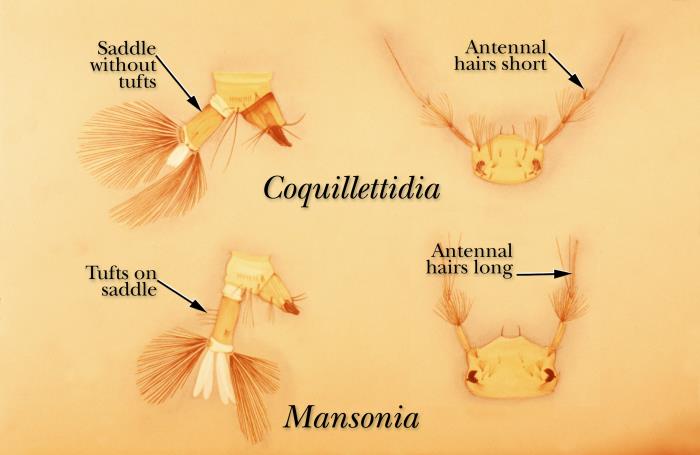
If the larva breathes through a plant, ordinary surface larviciding becomes a different problem.
Rutgers describes breeding habitat around roots and stems of emergent vegetation in bogs, ponds and lakes. The biology makes this a wetland-management issue rather than a typical flowerpot mosquito.
The CDC image here is a larval genus illustration. Adult confirmation should be done with a proper identification key.
Unusual larval biology
Coquillettidia larvae use modified siphons to attach to aquatic plant roots or stems and obtain oxygen from plant tissue rather than repeatedly surfacing.
Typical habitat
Rutgers emphasizes emergent vegetation around freshwater bogs, ponds and lakes; cattails and similar plants can be important habitat.
New Jersey significance
Rutgers documents Ocean County work identifying breeding habitat following EEE activity in horses and mosquito samples, illustrating the species’ surveillance relevance.
Why control is challenging
Larvae are concealed among plant roots and do not behave like ordinary surface-breathing mosquito larvae, making habitat mapping and treatment more specialized.
Adult pressure
Adults can be persistent biters and may move from wetland breeding areas into residential zones.
What it means for a homeowner
This is another case where the source can be a wetland complex outside the property. County mosquito-control surveillance and habitat knowledge become important.
Container-breeding Aedes
Aedes albopictus can be produced in a cup. Coquillettidia perturbans is tied to rooted emergent aquatic vegetation and a completely different larval breathing strategy.
Identification questions
Do Coquillettidia larvae come to the surface to breathe?
They are adapted to obtain oxygen from submerged plant tissue.
Can they breed in a backyard bucket?
That is not their characteristic habitat; emergent-vegetation wetlands are the key setting.
Why include them in a homeowner guide?
Because wetland-produced adults can affect neighborhoods even when the private yard itself is not producing them.
When identification points to a property-level problem, Bite Back can handle the professional side.
Jersey Mosquito stays educational. Bite Back is the service company for homeowners who want professional mosquito control in New Jersey.